Subscribe to Posts
RSS
Email

The Copenhagen conference on climate change of the upcoming week shall be dealing with serious challenges for our planet, economies and lifestyle. It is conceivable that climate change, if it is not stopped or stopping of its own accord, will also have an impact on our gardens. Planting (im)possibilities and shifting flowering times immediately come to mind.
Smaller changes in weather or climate are of course quite common, and have always been. The winter of 1822 has apparently been a warm one in The Netherlands, judging to the fact that a newspaper article used the example of one shrub that had been in bloom during the whole winter, to illustrate that point.1

Chaenomeles_japonicaIt grew in the garden of Beeckestijn, which is not far from the coast -and thus already in a milder climate because the relatively higher temperature of the sea water dampens the effects of winter in this part of the country. In the article the plant was called a “Pyrus Japonica” and it is possible that here the Pyrus japonica (Thunb) is meant; we now know this plant as Chaenomeles japonica, a prickly plant bearing fruit that ripens very late in the year.Pieris japonica
But it could also be the fine plant with small white flowers called Pieris japonica.2 Both plants were discovered or first described by the same botanist, Thunberg.
Carl Peter Thunberg was a Swedish student of Linnaeus who lived from 1743-1828. Continue Reading »


  1. “Haarlem, den 18 Februarij. Als een zeldzaam bewijs van de zachte luchtsgesteldheid, kan men aanmerken, het gedurende den geheelen winter in de opene lucht bloeijen, van eene Pyrus Japonica, op de hofstede Bekestein, onder Velzen. De gemelde plant heeft thans de hoogte van 8 voeten bereikt en bloeit ter hoogte van zes voeten. Men telt aan dezelve 150 bloemen en ruim zoo veel knoppen.” ‘s Gravenhaagsche Courant, 18 February 1822, page 1. [back]
  2. There is one obvious and popular mistake in the writing of the name, so we can’t exclude other possible mistakes made by the journalist or during the printing stage. [back]

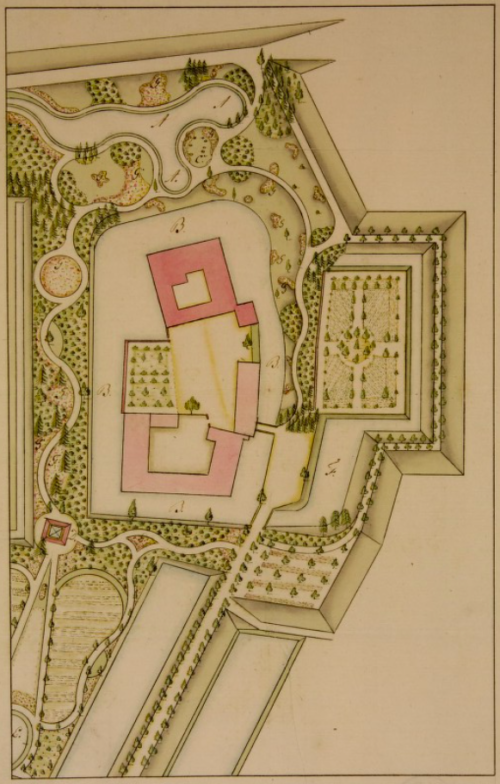
Interesting information has come to my attention in the last few months, and of course it has some bearing on the garden of Beeckestijn: avenues lined with two types of trees. On the Beeckestijn map (1772) we see such an avenue in the continuation of the central axis at the end of the garden, right in front of the colonnade.

Beeckestijn mixed avenue

Avenues are among the most formal and architectural features in any garden, and although their use may vary (lead the eye to a focal point, connect and pull together different parts of the garden, act as a screen or divider between garden parts), it is almost always characterised by the uniform appearance of similar trees placed in a linear pattern. This uniformity can become dull, and while dullness is not something any garden owner or architect strives for, many variations to the theme have been tried. Thus we find gardens in which the avenues are lined by a combination of different sorts of deciduous trees, like oak and lime. Around 1800 the Champs Elysées in Paris was lined with old chestnut trees, which, according to a visitor, formed a beautiful backdrop for the locust trees (Acacia) also planted there.1

What we see less often is an avenue lined with a variety of deciduous and coniferous or evergreen trees. This practise probably began just before the rise of the landscape style on the European continent. The attraction of such a combination is obvious: the avenue always retains some of its green and its capacity to form a screen. The general difference in growth form between the two types of trees is also attractive.
At Beeckestijn this may have been the case: the alternate depiction of ‘normal’ and pyramidal trees at least suggests this mix. We do not know what types of trees were planted here.

There are only a few other examples known in The Netherlands. I mention them here, because I hope to gather more information on this type of planting in avenues. Two of these examples date from the second half of the eighteenth century and the other was designed and planted during the 1890′s.
Starting with the latter, the Boombergpark in Hilversum, there was a special purpose to the alternate planting of beech and larch. According to the authors of a recent book on the park, the larches were used as sun blocks, to protect the sensitive bark of the freshly planted beech trees.2 This view is supported by the fact that the larches were cut out 25 years later because they had “lost their purpose”. Boombergpark_mixed_avenueIn his design for the Boombergpark in Hilversum, landscape architect Dirk Wattez used this kind of planting for two avenues. One was a single lined, slightly winding avenue on the western side of the park where different kinds of trees are planted alternately along the side of the paths. The other -straight- avenue was on the eastern side of the park, with two rows of trees on one side and three on the other (see right hand image). Where there are three rows of trees, they are planted in a quincunx formation, with again alternating sorts along the roadside. Wattez used a smart pattern here, because his plantation was set up in such a way, that from whichever way one looked, there were never three trees of the same species planted in one line. So although the larches may only have had a practical use in the end, Wattez made sure they made an aesthetic impression while they lasted.

The two 18th century examples are Beeckestijn and Twickel. The original planting of both avenues is long gone, leaving us with no information about the species planted there. Two contemporary German examples, of which we do know which species were used, show some possibilities.
The first is not far from The Netherlands, in fact just over the border with Germany in the garden of Kleef (Kleve). In 1781 an avenue of beech and fir was mentioned by Pieter van Winter.3 Van Winter admired the contrast between the colours and texture of both sorts (bright green and soft for the beech; paler green and needle-like for the fir tree). He also says the trees had grown considerably since he saw them earlier, which indicates the trees must have been planted somewhere in the 1760′s or 1770′s.
The second German example is near Aschaffenburg: Schönbusch. Like Beeckestijn, this garden was a mix of baroque elements and landscape garden design, although the execution of the landscape garden at Schönbusch was much bolder than the Dutch garden. For a more formal part of the garden, head gardener Müller was told by the Prince-Elector (Kurfüst) to transform a chestnut avenue into a mixed avenue. He was ordered to plant large larches between the chestnuts: “(…) [zwischen] 2 Kastanien-Baümen jedesmalen ein wohlgewachsener Lerchenbaum hineingepflanzet werden solle (…)“. The reaction of the Prince-elector’s advisor Sickingen is telling: he thinks this is not a good idea, because in his view planting larches between chestnuts in a straight avenue alongside water is of and old fashioned artificiality that was not suitable for a modern garden like Schönbusch.4

Going back to Beeckestijn, current belief is that this mixed avenue was planted between 1755 and 1760.5 This fits in with what both German examples show: planting mixed avenues was en vogue in the third quarter of the 18th century. It appears to have been swept away by the landscape style coming in from England during that same period. Some of the early landscape gardens kept these mixed avenues intact, possibly because they were still deemed to be modern enough to last for a while.
Beeckestijn_avenueDuring the reconstruction ten years ago, in a long and difficult discussion about what to plant here, a compromise was reached: a combination of lime and thuja was planted in this avenue. I was present at that discussion and I believe it is safe to say that none of the participants was happy with this choice. But politically it was the only combination possible at the time.
Back then, the information cited above was not available to the restoration team. Now Beeckestijn is on the threshold of a new start, and the thuja’s are suffering and lagging behind the lime trees (or just plain dead), it is not too late to use this information and do the right thing: dig out the thuja’s and plant firs or larches instead.

Please. It can be done in the next months.


  1. Pieter van Winter, writing to his daughter in 1802: “(…) ook doet de importante hoogte en zwaare belommering van oude kastanjeboomen en Acacia’s die tegen elkander een goed effect doen veel tot het schoone gelyk mede de stoffagie van duizende Wandelaaressen zeer voïant gekleed.” Letter from June 24, 1802, found in the Six collection (Amsterdam) inv.nr. 73683. I thank Ruud Priem for this information. [back]
  2. Piet Bakker (et.al.), Het Boombergpark in Hilversum: verleden, heden en toekomst van een monumentaal wandelgebied (Hilversum 2005). [back]
  3. Pieter van Winter, writing to his parents in 1781: “(…) by ons men heeft thans veele laanen met beuken en sparren om den anderen die sedert ik die gezien heb, vry wat gegroeit zyn en een admirabel adspect opleveren in ‘t groote daar ‘t levendig groen en zagt blad der eerste door het vaalder en penachtig blad der laatste; aardig word gecontrasteert (…).” I am not exactly sure what he means with the ‘by ons’ (here). He was traveling, so he could be referring both to home, or to his location at that moment. Letter from July 16, 1781, found in the Six collection (Amsterdam) inv.nr. 73661. I thank Ruud Priem for this information. [back]
  4. J. Albert, W. Helmberger: Der Landschaftgarten Schönbusch bei Aschaffenburg (Worms 1999), p49, ill. 79 and note 197. [back]
  5. This part of the garden was only added to Beeckestijn in 1755, and in 1760 the owner decided to start laying out his new garden in the landscape style he saw in England. The mixed avenue must be designed during those years. [back]

Cricket on Beeckestijn

After last night’s surprising victory over England by the Dutch cricket team, which has caused both a shock and words of praise in Britain, one has to wonder where it all began. Certainly, cricket in Holland has never grown into a large and important sport, but as it turns out it was introduced at least as early as 1765.
The earliest reference to cricket in Holland I know of (mind you, I am not an expert in cricket), comes from the Boreel family, the owners of Beeckestijn. In reply to a request dated 23 August 1765 by Willem Boreel, Jean Palairet (agent in London of Willem’s father Jacob) confirms he had bought 4 balls (12 shilling) and 12 bats (12 shilling).1 A week later he writes extensively about the name of the ship carrying the “masses de jeu de crickett et des douze boules”, but somehow forgets to mention the ship’s name itself.2

In his first letter Palairet states that he is still on the lookout for a rule book. Although these ‘Laws of Cricket‘ existed since 1744, a printed rule book based on revisions agreed upon in 1774, was not published until 1775. So it is safe to say that the Laws of Cricket probably never made it across the North Sea earlier than that.
That would not have stood in the way of a good match at Beeckestijn, though, because back then the game knew many different rules and forms. A major standardisation of the game only came about in 1809. The fact that none of the open areas in Beeckestijn‘s garden is big enough to house a cricket field by modern standards, would not have posed a problem: the first laws of cricket only dictates the size of the pitch, the distance between the wickets and where the bowling and popping creases should be. The size of the surrounding field where the field players are, seems to have been open to interpretation and circumstances.
Finding opponents would not have been difficult as well. Willem attended college in Leiden (Leyden), at the time a university which drew students from many countries in Europe, including many from England.3

cricketbeeckestijn-kopieIf we were to play a match on Beeckestijn by modern standards, we would be forced to play on a field just next to the garden proper, now in use as a meadow for horses (see my poor rendering of that situation on the left).4 Instead, wouldn’t it be nice to commemorate the 1765 introduction of the game at Beeckestijn with an annual historical cricket game, taking place at either the small or the big field in the landscape garden the family created in exactly the same period? Attention in the media and any proceeds of the game could then be used to support the future exploitation of Beeckestijn, after all one of te most important gardens in The Netherlands.

How on earth did Willem Boreel learn about cricket so soon? Continue Reading »


  1. These amounts are confirmed by a receipt in the Boreel family archive. [back]
  2. Both letters from Palairet are kept in the Boreel family archive at the Nationaal Archief in The Hague. Willem Boreel’s request has not yet been found. [back]
  3. Willem Boreel became close friends with James Harris, later the first Earl of Malmesbury, who attended classes in Leiden from September 1765 till the spring of 1766. [back]
  4. This field is now an important archaeological site, making it highly unlikely a game would ever be played there. [back]

Things have been fairly quiet surrounding Beeckestijn the past year. To remind ourselves where things stand: last year, the decision was made to transfer the estate from the Velsen council to nature preservation society Natuurmonumenten. That could not be done directly, so Beeckestijn was transferred to a ‘middle-man’, the Dienst Landelijke Gebieden (DLG), a subdivision of the Ministry of Agriculture. The final transfer was expected to be done swiftly, reason for the future owners to announce a first presentation of the bright and shiny future in December.

The neo gothic ‘chapel’ at Beeckestijn is one of the remaining buildings that is mentioned on the map of 1772. Photo by HvdE.

December 2007, that was… Now, a full year later, the final transfer has not yet been finalised and DLG is still sole owner of the estate.

Meanwhile the council of Velsen agreed upon a new zoning plan (links to .pdf-file) for the area Beeckestijn is located in. And that zoning plan does make future developments of Beeckestijn as a self sustaining estate just a little bit more difficult.1
At least, that is what a local paper concludes.2 One of the plans of the future owners was to rebuild the orangery that was demolished after WWII, and use it as a tearoom with a terrace, maybe even a shop. This would surely attract visitors and bring in much needed money. The zoning plan now blocks that plan in two ways:

1. The plan states that no additional catering industry vending points are allowed in the whole zoning area, unless it is planned in the area surrounding Velserbeek, an estate more to the north of Beeckestijn. According to the plan Beeckestijn already has a bar/restaurant on its premises which could remain there, but that has been closed since late spring 2006.

2. The more decisive point in the zoning plan is this: the only reason the council will support a new structure to be built, is when it is mentioned on ‘the map of Michael (1772)’.3 This can only apply to Beeckestijn, although it is not mentioned as such in the text. Michael is the architect of Beeckestijn, or at least the head gardener and the one drawing the map of 1772. There is no other location that Michael drew a map of in 1772, as far as I know.

The orangery would have been located just on the other side of the hedge. Photo by HvdE.

The orangery is not on that map. And although the orangery has been around for some 150 years, the fact that it does not comply to that rather arbitrary criterion imposed on Beeckestijn by its former owners, one of the few new ‘cash-cows’ for the future owners of Beeckestijn has been denied, the local paper implies.

The local paper did not take another section of the zoning plan into account, though. In section 8.2, on page 55, it is stated that current owner DLG believes the zoning plan is too strict when it comes to Beeckestijn.4 The council says in response it still prefers the restrictive line it originally intended to take as far as building plans are concerned.
But. It also states that any future building plans will be examined closely by the council, which may result in a cooperative attitude from their side.

So all is not lost. But it may make the final transfer of the estate to its future owners a bit more difficult, I presume.


  1. To be fair, it also creates room for extra developments that could make the garden more attractive to visitors. More about that in later posts. [back]
  2. The IJmuider Courant brought that news today. [back]
  3. Zoning plan section 7.3.3., page 22. [back]
  4. Section 8.3 seems to be missing from the plan. [back]

First steps…

Earlier this month, the first step in the transfer of Beeckestijn to its new owners was finally completed by the transfer of ownership from the Velsen council to the department of DLG.1 It has taken all parties involved almost 6 months to agree on the terms and conditions under which the transfer takes place. It is now up to DLG and the designated owners (Vereniging Natuurmonumenten, Vereniging Hendrick de Keyser and one private financier) to finalise the full transfer and present the new plans.In early July the new owners stated they would have the plans for Beeckestijn‘s future ready and present them at a first exhibition in December 2007. The fact that now only the first step in the process has been finalised is evidence that these talks are more difficult than originally expected.If one looks at the constellation of the new ownership, it is hardly surprising these talks have taken so long. Every party involved at the receiving end of the deal has their own ideas and preferences for the future of the estate. And because the estate is not sold but traded for development areas elsewhere in Velsen, the parties that are giving Beeckestijn away also have a say in its future. The parameters set by the ‘giving’ parties are:

  • the estate should remain open to the public (Velsen council).
  • the new owners must be able to maintain the estate in a sustainable way for a considerable time (the Province of Noord Holland).
  • [there used to be a demand to maintain the unity between house and park, expressed by the Velsen council earlier in the process, but I do not see this anymore]

On the receiving end, the parties involved have already shown they are capable of working together, but their preferences are difficult to combine. They need to find a balance between the ecological relationships between the garden and surrounding area one the one hand, and the simultaneous creation of a museum of gardening on the other, all within the parameters the giving parties have set.No one’s saying this will be easy, but the first step has been made.


  1. See for more information on the transfer and the organisations involved here, here and here. [back]

Full moon

vollemaan.jpgYou may ask yourself: “What does a picture of the moon have to do with historical gardens?”. My answer: more than you presumably think (and the fact that it is a great picture is in itself reason enough to show it here).1 For example: for centuries gardeners have loosely scheduled large portions of their work -pruning, sowing, harvesting- on the moon’s cycle.2

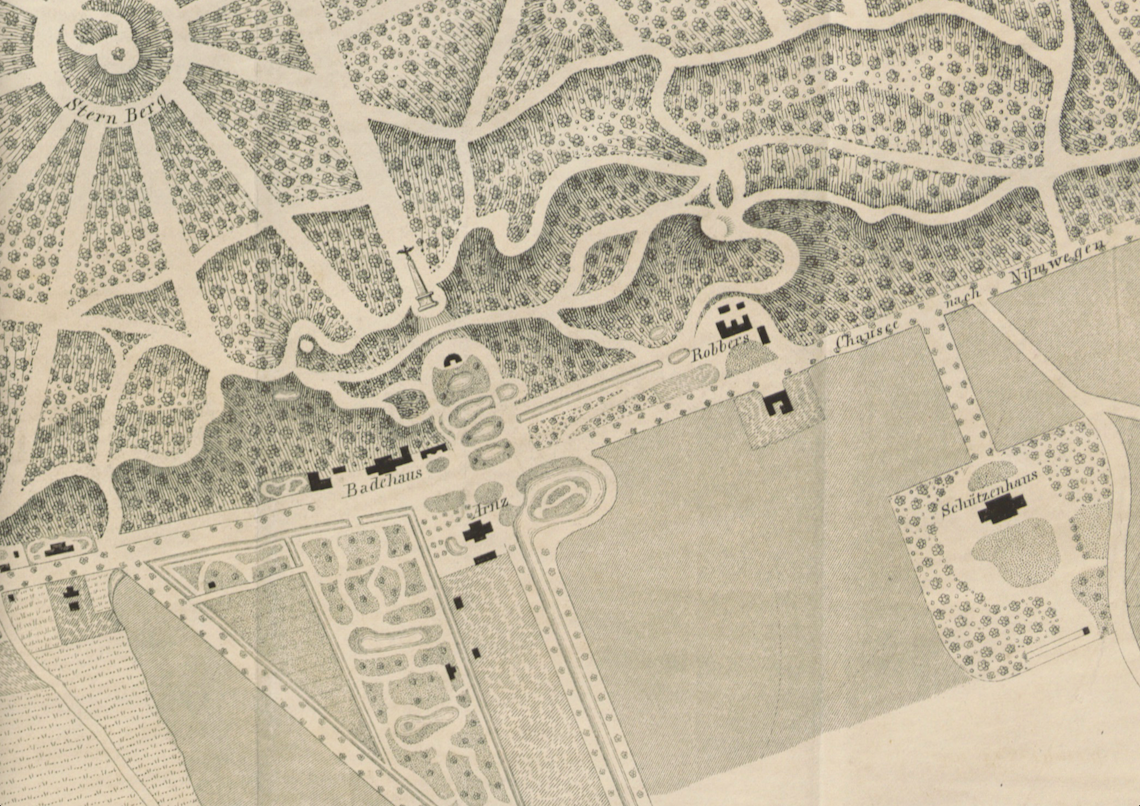
Another way in which gardens and the moon can interact, is the way it is done at Beeckestijn. There, on the 1772 map of the estate, part of the menagerie is a circle with a plan that can best be described as a stylised map of the moon: the bright spot in the lower part of the circle is on the same location as the large crater on the moon’s surface, known as Tycho crater. fullmenagerie.jpg The other forms and shapes -in essence: the lights and darks- may not resemble the moon for a bit, but that is less important. I’ll try to explain why I think that is the case -and why I believe this part of the garden symbolises the moon.

Quality of the available source material is one of the issues to address. The large crater can be spotted with the naked eye (even from the largely urbanised place where I live, with nothing but ‘light pollution’ around), whereas the other parts of the surface can be difficult to discern without the right gear and instruments. To us, the actual surface of the moon is known and available in an instant, through top of the range telescopes, photography and internet. For people in the 1760′s, when this garden was laid out in the form known to us through the 1772 estate map, that wasn’t the case. Ofcourse people knew what the moon looked like, they may have looked at it better than most of us ever have. But we know what the moon ‘exactly’ looks like just because we have good representations of the moon’s surface at hand, enabling us to better understand the surface than we would ever be able to by seeing for ourselves. What they saw, is exactly the same as what we see. But their representations of the moon have left more room for interpretation than ours.moonency1767med.jpg

The picture on the right is such a contemporary representation of the moon’s surface. It was published in what in those days must have been the benchmark of knowledge: l’Encyclopedie by Diderot. This image is taken from the Astronomie-section in the VIIth part of that immense work, which was published in 1767-68.3 It shows the same view of the moon we have today. The engraving is a fairly exact representation of the moon’s actual surface, but there are slight differences, caused mainly by the coarseness of the engraving. Apparently this image was deemed a good enough representation of the moon; we could all go out at night and see for ourselves to check. But it is also a highly schematic representation of the moon, which allows room for interpretation and different views.

Thinking along those lines there is another issue: we must ask ourselves how important it may have been for the designers and owners of Beeckestijn to recreate an exact image of the moon’s surface. The fact that it sort-of resembled the moon might have been sufficient, just like the fact that Beeckestijn’s triumphal arch was probably painted on a piece of wood and would only have looked real from a distance. There are many, many more examples of these practices in The Netherlands throughout the ages, I mentioned a contemporary one earlier, from an English student in Leyden, traveling between Delft and Leyden in 1765:

‘The passage there is very pleasant, the gardens of the Merchants running the whole way down the river; by what I can see of the Dutch gardens they are infinitely inferior to ours, & seem to be greatly behind us in Taste, their only ecxellence is their neatness which is extraordinary – their decoration is odd, they fill their gardens with paintings, & if they want to lengthen a walk, they paint a gravel one on a piece of board, to deceive the Eyes & I saw more than one painted Aviry (sic)’.4

Besides that it still is a garden and no matter what message someone wants to convey with the design of parts of the garden, it still needs to be practical. In this case this means that where copying the exact surface of the moon would have left the owner with an unpleasant walk, the surface is stylised and adapted in such a way as to primarily work as a garden feature, and secondly convey an inaccurate, yet convincing image of the moon.

The interpretation of this garden feature is in my view obvious when we notice a similar styling on the opposite side of the central axis at Beeckestijn, where the flower garden forms a mirror-feature of the menagerie, both near to, and at the same distance from, the main house.5 beeckestijncore.jpgHere we see a circular form, consisting of bend curved flower beds spiralling outward from an open centre. These spiralling flower beds can be viewed seen as the rays of the sun, and the whole flower garden as a representation of the sun. Both features have been identified as the moon and sun before.6Beeckestijn 1772 in full We cannot be sure whether these designs actually stand for the sun and moon, but it seems likely.

To return to the central topic with a question: why would someone be keen to have the moon visualised in the menagerie of his garden? There are many posible answers possible to that question, and it is very tempting to put one of these forward as a definitive one. But the truth is we don’t know at all. It is quite possible both garden feautures represented the ‘male’ (sun, flowergarden) and the ‘female’ (moon, menagerie), as we see happening in more gardens in The Netherlands: like an echo of the prince and princesse’s gardens at Paleis Het Loo in the 17th century. Antoher possibility is one that has been linked with the 1772 map earlier by Heimerick Tromp, where various garden features are said to contain symbols that point towards the Freemason movement.7 In this case he also identifies the moon on the 1772 map, but in a different section of the garden. beeckestijnsunandmoon.jpgThe then owner of Beeckestijn, Jacob Boreel Jansz., is not listed as a freemason, but two of his grandsons (one also called Jacob, the other Willem François) became one later on. A tantalising hint towards Mrs. Boreel also being interested in the Freemasons comes from a letter sent to her husband Jacob by a friend, Cornelis Backer. At the time, Jacob Boreel was in London, sent out as an envoy on behalf of the Dutch government. It was his responsibility to maintain the right for Dutch ships to transport goods during the Seven Year’s War (in which The Netherlands were neutral, but the English accused the Dutch of transporting goods on behalf of the French, with whom England was at war -ofcourse we never did such a thing :0).8 Cornelis Backer wrote on the 11th of June 1759:

“Hede morgen had ik de Eer te ontfangen die van UHEdGest. der 8 jongstleden; ik heb daar op de papieren van UHEdGestr. rakende de free masson van Mevrouw Boreel; onder mijne recepisse ontfangen en zal daar op alvorens te berichten (…) met den Heer R.P. in den Haag spreeken.”9

Sadly, we don’t have the original letter and papers Boreel sent, and a reply on the subject is also missing (or: not found yet). It is strange that it was Mrs. Boreel who is mentioned in relation to this, because as far as I know, the Freemasons remained a strictly male brotherhood until the end of the 19th century.

In conclusion (for now): I believe the layout of the menagerie at Beeckestijn is meant to represent the full moon. It is not a direct copy of the moon’s surface, mainly because that probably was not important but it would also not be usefull as a garden feature people should be able to walk through. The date of the design must lie between 1760 and 1772, but it is possble the design leans heavily on the engraving in the Encyclopedie, pushing the date forward to between 1768 and 1772. The reason why Jacob Boreel chose to depict the moon in his menagerie is unknown, even when we take into account that it mirrors a representation of the sun on the other side of the central axis.

Comments and suggestions are very welcome.


  1. Source: mattie_shoes photostream on flickr [back]
  2. Gardener’s calendars at least until the end of the 18th century have an abundancy of references like this: “sow after the third new moon of the year” -although the religious calendar was very important as well, but in reformed Holland the saints -for obvious reasons- were not as important as elsewhere. [back]
  3. The image is rotated, not just to put it in the same direction as the other images used here, but because we actually see the moon like this at our longitude. The Beeckestijn version must have been created in the same period: the style of the design is very much in line with what we know about the early landscape style, adopted in The Netherlands around 1755, but slowly finding its way into Dutch society during the 1760′s and 1770′s. [back]
  4. He means to say: Aviary. James Harris to his father, September 16, 1765. Source: Hamphire Record Office (Winchester, England), Malmesbury family archive, inventory 9M73, inv.nr 262/5 [back]
  5. The main house is the dark blob below in the centre. [back]
  6. Joke van der Aar & Siebe Rolle, Een beeld van een buitenplaats: de tuinen van Beeckestijn, Museum Beeckestijn, Velsen-Zuid, 2000, p44-45. There is one problem with this identification: it can only be presented in a convincing way, when we take both features into account. It is difficult to prove these identifications when we focus at each individual feature. [back]
  7. Cascade 15 [2006], nr. 2, p. 6-13. In Freemasonry, the sun and the moon are important elements. [back]
  8. Holland wanted to hold on to a free-trade treaty both countries agreed upon in 1674. England felt the treaty was outdated and -mainly- did not serve their needs anymore, as England was on the rise and Holland had become an ecomically less important state. [back]
  9. A selfmade translation, using some shortcuts: “This morning I received your [letter] dated June 8. I have also received your papers with regard to the Freemasons of Mrs. Boreel”. He goes on saying that he will discuss the matter with one of the highest politicians (the mentioned “R.P.”, which are not his initials, but those of his function: Raadspensionaris. I have yet to find an English equivalent for that. His name was Pieter Steyn, though.) in Holland, and he’ll reply on the subject later on. Source: Nationaal Archief, Boreel family archive, inventory 1.10.10, inv.nr 132.Cornelis Backer was the owner of Sandenhoeff, a small estate in Overveen. [back]

In a predictable turn of events, the arrangements surrounding Beeckestijn have led to questions in parliament (Tweede Kamer). Mrs. Snijder-Hazelhoff, member of parliament for the oppositional liberal party (VVD) and -according to her profile- dairy farmer in the northeastern part of The Netherlands, directed questions to the Minister of Agriculture (Gerda Verburg -CDA) on the legitimacy of the process, and whether other parties (read: market parties) have been considered in the process.

The last point should have been quite clear for someone with only the slightest grasp on the recent history of this estate: just over a year ago plans to sell the estate to a market party were blocked by both local and national politicians. I know we have had Italian-style changes in national and local politics in the past few years, but one would expect that someone would do some reading into a subject, before going public with questions like that.

However, one can see why she questions (pdf-link) the process followed in this case. As a farmer she must have dealt on a regular basis with the ministry of agriculture, and maybe its subsidiary Dienst Landelijke Gebieden (DLG -national service for rural areas) as well, and she might be worried. When local politicians were looking for a solution for Beeckestijn, DLG stepped in with a solution favourable to almost everyone: DLG would be taking over the estate and some surrounding grounds in exchange for areas in DLG‘s possesion in Velserbroek, part of Velsen. In addition to that, Velsen would get the opportunity to use these new grounds as a development area, in which way they’d secure a bigger revenue for losing the estate than by just selling it to the highest bidder. In the mean time, Beeckestijn would be ‘passed on’ by DLG to nature preservation society Natuurmonumenten and partners, who declared they wanted to restore and maintain the estate. Everybody happy.

Except for the farmer whose land lies in Velserbroek, within the area given away by DLG as development plot. Continue Reading »

The previous owners closed Museum Beeckestijn in January 2006, to save money. The new owners (since last week) have already said they wanted to create a centre for garden and landscape architecture at the estate and to have the museum reopened.

The latest news is that the museum is going to have a flying start. The chairman of the Foundation of Friends of Beeckestijn (Stichting Vrienden van Beeckestijn) told Haarlems Dagblad the first exhibition will be staged in December 2007. The exhibition will revolve around the plans the new owners have concerning Beeckestijn‘s future.

Next »